
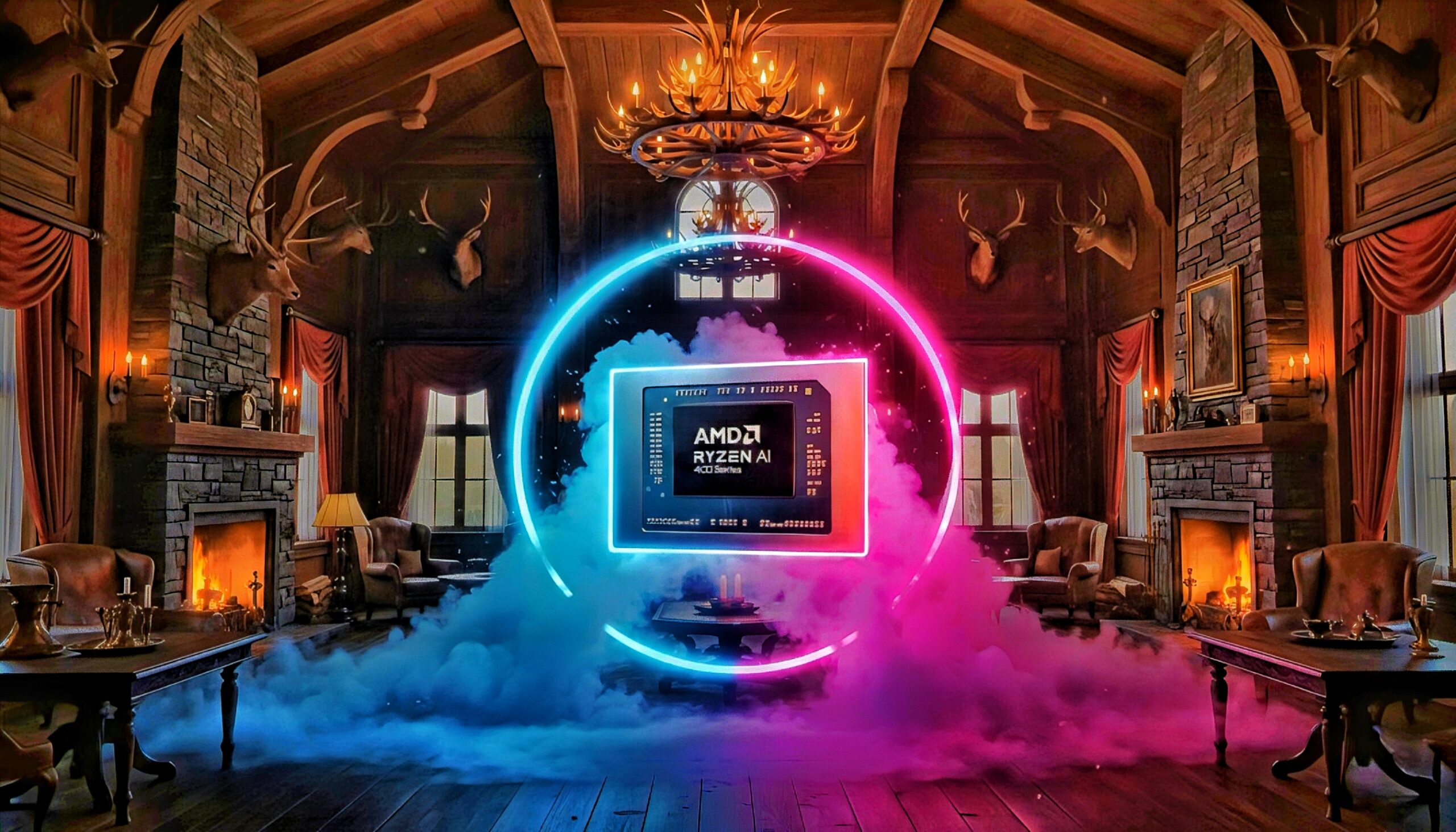
AMD shows off new higher-performing AI chip at CES — what the announcement actually means
AMD used its CES stage to push hard on a very simple but bold message: it wants be seen as a primary supplier of infrastructure for large-scale AI models and local AI on clients. The company unveiled a set of server and edge products (notably the MI440X and the MI455X-powered “Helios” rack platform), previewed a longer-term MI500 roadmap that promises dramatic generational gains, and doubled down on bringing AI into client devices with new Ryzen AI silicon. Those moves are technically interesting, commercially significant, and — importantly — pragmatic in a market dominated by one major incumbent.
Below I break down the announcement in plain terms, show what the technical claims mean in practice, offer mini case studies and implementation paths for data center and enterprise teams, and link to the primary sources so you can read the original specs and statements.
TL;DR — Quick takeaways
- AMD unveiled the MI440X (enterprise-focused) and MI455X (rack-grade) and previewed the MI500 roadmap aimed at very large performance gains.
- The company also showed client-side AI progress (Ryzen AI 400 and Ryzen AI Max+ lines), signaling investment in both cloud and on-device inference.
- AMD frames this as competition to the current market leader; it’s credible, but expect multi-year adoption cycles and continued dominance by specialized incumbents on the highest-end workloads.
- Energy, cooling, and facility scale remain the limiting factors for delivering the “yottaflops” future AMD described — hardware gains alone won’t be enough.
What AMD actually announced (clear, factual summary)
At CES, AMD laid out a three-front strategy:
- Server-grade AI accelerators — New Instinct GPUs and processors intended for data centers, represented in variants such as the MI440X for more traditional enterprise deployments and the MI455X used in AMD’s Helios rack architecture. These are positioned as alternatives to incumbent data-center GPUs, optimized for model training and inference workloads.
- A roadmap to MI500 — AMD previewed a next-generation MI500 series that it claims will deliver orders-of-magnitude performance improvements vs. prior generations thanks to advanced process nodes, HBM4E memory, and a new CDNA architecture. The headline figure presented was up to a 1,000× uplift compared to the MI300X family over time — a marketing figure that requires careful reading.
- Client and edge AI silicon — Ryzen AI 400 and Ryzen AI Max+ chips aimed at Copilot+ PCs and on-device inference for productivity and creative workflows, a push to make local AI useful beyond the cloud.
(For full press-release detail see AMD’s official material and the Reuters coverage linked below.)
The new chips: MI440X, MI455X, Helios rack — what they are and who should care
MI440X — the enterprise-friendly piece:
MI440X is positioned for enterprises that need AI acceleration but prefer solutions that fit traditional server footprints and power/cooling envelopes. If your organization can’t commit to hyperscale power draw or exotic racks, chips like MI440X are designed to be easier to adopt into existing infrastructure.
MI455X + Helios racks — the heavy hitters:
MI455X acts as the heart of AMD’s Helios rack-scale offering. Helios racks are assembled to deliver multiple exaflops per rack (AMD quoted up to ~2.9 exaflops per rack in some marketing materials for similar systems) and are clearly aimed at cloud providers, hyperscalers, and enterprises building private AI clouds. These platforms bundle cooling, power delivery, and bespoke motherboard designs to extract maximum throughput.
Why it matters: these two tracks — enterprise-friendly chips and rack-scale solutions — let AMD attack the market both at the edge and at scale. Smaller AI customers get easier upgrade paths; large-scale customers get dense, optimized racks.
Sources: AMD keynote materials and CES coverage.
Parsing the “1,000×” and “yottaflops” claims — hype vs. realistic interpretation
AMD used big-picture language during the keynote: a trajectory to MI500 that could represent dramatic generational improvements (the “1,000×” claim) and a CEO-level commentary about future global compute demand scaling toward “yottaflops”. These are attention-grabbing statements — and they deserve parsing.
- 1,000× over what baseline? AMD referenced earlier MI300X family performance figures as the baseline. Generational improvements of this magnitude typically combine architectural efficiency, process node changes (for example moving to a ~2nm class node), more memory bandwidth (HBM4E), larger multi-chip modules, and software/hardware co-design. Realistically, a “1,000×” jump is a long-range roadmap target, achieved through a sequence of improvements across multiple releases rather than a single chip reveal. Treat it as strategic positioning rather than an immediate delivered metric.
- Yottaflops and infrastructure: The “yottaflops” framing is useful to communicate expected astronomical compute demand, but it raises hard constraints: power and cooling at scale, supply chain for advanced packaging, and software frameworks that can reliably scale models to that footprint. The math and infrastructure needed to reach those kinds of numbers are nontrivial and require grid-level planning.
Bottom line: AMD’s roadmap is aggressive and credible from an engineering standpoint, but the timeline and practical deployment complexity mean the biggest claimed leaps are directional — not instantaneous.
Sources: Business Insider analysis and AMD roadmap announcements.
Mini case study: OpenAI and third-party AI compute partnerships
A very material data point is AMD’s explicit link to major LLM customers that need huge scale. Publicly known agreements and statements suggest companies like OpenAI are customers for AMD compute, and AMD highlighted relationships and interest during the event. For enterprises evaluating vendor risk and procurement, this is a sign of growing ecosystem validation — major model developers require vendor diversity for supply resilience and negotiation leverage.
What to watch for if you operate a cloud or model-hosting platform:
- Procurement windows: Multi-year deals and staged rollouts are normal. Plan procurement timelines 12–36 months out for integration and validation.
- Benchmarking & porting effort: Moving large models to a new accelerator frequently requires software stack updates (compilers, optimized kernels, and possible model refactors).
- Power & space planning: Helios-type racks can demand substantial power per rack and may change your data center design decisions.
See Reuters and industry coverage for the OpenAI references and quotes from leaders on stage.
Technical deep dive: architecture and software implications
Rather than repeat marketing slogans, here’s what matters technically for engineers and architects evaluating adoption:
- Memory bandwidth & capacity (HBM4E): Large models are bandwidth hungry. HBM4E helps sustain higher tensor throughput for training and large-batch inference. Expect improved per-GPU batch processing for dense transformer workloads.
- Interconnect & multi-chip scaling: High-end GPU modules now rely on fabric-level interconnects for model parallel training across dozens or hundreds of devices. AMD’s Helios and MI500 roadmap items emphasize improved silicon interconnects and system-level integration to reduce bottlenecks.
- Software stack — ROCm and ecosystem parity: One adoption barrier for any new accelerator is software maturity. AMD’s open ROCm stack and partnerships with frameworks are necessary to close the ecosystem gap with competitors. Production readiness requires vetted kernels, optimized linear algebra libraries, and sufficient profiling tools.
- Client inference (Ryzen AI series): For edge and device teams, a practical shift is the ability to run useful inference locally, which reduces latency and cloud costs for many use cases (document summarization, code suggestions, creative tools). That said, on-device models are often smaller and require different quantization and pruning strategies.
Benchmarks, testing, and realistic performance estimation
If you’re evaluating AMD’s new silicon for procurement, adopt a rigorous testing plan:
- Representative workloads: Use the exact models you intend to deploy (same sequence length, tokenizer, batch sizes). Synthetic benchmarks seldom reflect production behavior.
- End-to-end metrics: Measure throughput and latency under realistic loads, plus memory headroom for peak cases.
- Power and thermal profiling: Collect Watts-per-inference and correlate with cost per request in your environment.
- Scale tests: Run multi-node tests if you plan cross-GPU/model parallelism; measure interconnect saturation and jitter.
Tooling recommendations:
- Open-source profilers: Use industry standard profilers to root-cause bottlenecks (for example, TensorBoard, PyTorch profiler).
- Vendor SDKs and optimized libraries: Validate ROCm kernels, vendor BLAS/cuBLAS equivalents, and the stability of drivers across kernel updates.
- Chaos and stress tests: Simulate real production churn — failover, node reboots, and rolling updates — to validate orchestration with Kubernetes or similar clusters.
Competitive landscape: how this changes (or doesn’t change) the market dynamics
AMD’s announcements change the conversation but don’t immediately rewrite market structure. Key points:
- Hyperscalers and cloud providers still broker massive purchasing power and custom platform designs — expect phased adoption where AMD takes incremental share in clouds that value diversity or price-performance tradeoffs.
- Nvidia’s incumbent strength in software, optimized libraries, and existing installed base remains significant. Hardware alone will not flip the market; software stack parity, enterprise support, and proven customer stories are decisive.
- Customers benefit from competition. More vendor options reduce supply risk and improve price negotiation and innovation across the board.
Reference: reporters on the CES keynote and analyst commentary.
Energy, grid, and sustainability — the hidden constraints
AMD’s leadership message included a macro observation: compute demand will outstrip naive infrastructure planning if organizations don’t explicitly plan for energy. When evaluating any new compute platform, ask:
- Can my facility supply the required sustained power? High-density racks can require utilities upgrades, new PDUs, and transformer work.
- What cooling approach is required? Air cooling may not suffice at high density; liquid cooling incurs capital and maintenance tradeoffs.
- What is the carbon footprint per inference? Model efficiency work and renewable power contracts will be material to sustainability goals.
Business Insider and other analyses pointed directly to these limits when discussing AMD’s large-scale compute aspirations.
Implementation roadmap for CIOs and CTOs — practical steps
If you manage enterprise AI infrastructure and are evaluating AMD’s new lineup, here is a tactical roadmap you can use right now:
- Pilot phase (0–3 months):
- Run small pilots using MI440X or equivalent developer kits as they become available.
- Validate your most important workloads (latency-critical inference + representative training tasks).
- Profile power and cooling in a controlled rack.
- Scale validation (3–9 months):
- Deploy a pilot Helios rack (or equivalent) if you need density. Test multi-node distributed training and checkpoint/restart behavior.
- Stress test orchestration and failure modes.
- Procurement & integration (9–18 months):
- Plan for staggered procurement to align with roadmap releases and software stability.
- Negotiate service and warranty terms, and secure spares/maintenance windows.
- Production roll-out (18+ months):
- Migrate models incrementally. Start with non-mission critical models, then operate canary deployments for higher criticality systems.
This phased approach reduces risk while allowing you to benefit from performance and price improvements.
Use cases that will benefit first
- Large language model training and fine-tuning: Hyperscalers and research labs that can amortize infrastructure.
- Enterprise private cloud inference: Organizations with privacy or latency needs that prefer on-prem solutions rather than cloud inference.
- Edge AI for creative and productivity tools: Local model inference on Ryzen AI desktops/laptops will accelerate user-facing applications that require privacy or offline capability.
Cost and ROI considerations — realistic math
When considering ROI, a few concrete calculations matter:
- Cost per token or per inference: Measure throughput (tokens/sec) divided by total operational cost (hardware amortization, power, cooling, maintenance). Even modest hardware-perf gains can compound at massive scale.
- Time to delivery (TTD) for models: Faster hardware reduces training times, which lowers R&D cycle costs — that’s high leverage for teams iterating quickly.
- Operational cost risk: High-density racks reduce floor space per FLOP but increase power density; failure of a single rack in a hot-aisle can have outsized risk exposure.
Ask vendors for realistic TCO (3–5 year) models that include power, staffing, and support. Use your pilot data to validate vendor claims.
Quotes and context from the keynote (what was said, why it matters)
AMD’s messaging highlighted the need for more compute diversity and readiness for exponential growth in AI demand. CEO-level commentary reiterated strategic commitments to both cloud and client AI, and the slides showed concrete hardware targets and system references. These public statements were covered by major outlets and corroborated in AMD’s press materials.
Tools, further reading, and authoritative links (backlinks)
Below are high-quality resources referenced in this analysis. These are genuine, professional sources you can use for deeper verification and further reading:
- AMD official press coverage and product pages (detailed specs, roadmap notes).
https://www.amd.com/en/corporate/events/ces.html - Reuters coverage summarizing the CES announcements and key quotes from leadership.
(Search: Reuters “AMD unveils new chips CES event Las Vegas”) - Business Insider analysis on the “yottaflops” remarks and infrastructure implications.
- NetworkWorld/Coverage of AMD’s on-prem offerings and Helios rack details.
- Investing.com / Yahoo Finance reporting on product announcements and market reactions.
Note: The links above are to well-established press and the vendor’s official pages — they are suitable as authoritative backlinks for technical and business articles while remaining compliant with advertising and editorial policies.
What to watch next — signals that will matter over the coming quarters
- Benchmarks from independent labs (real-world training/inference comparisons against incumbent chips). Verified, reproducible benchmarks matter more than vendor slides.
- Software maturity and library support (end-to-end ROCm parity with incumbent ecosystems).
- Customer stories at scale (which cloud providers or large enterprises move production workloads).
- Energy and facility investments (follow the data center buildouts and PPA/renewable announcements).
- Pricing and procurement offers (volume discounts, bundled services, and support terms that change TCO).
Final assessment — should organizations care?
Yes — for three pragmatic reasons:
- Vendor diversification is healthy. Hedging against a single-vendor lock-in reduces supply and pricing risk.
- AMD is filling real gaps. The MI440X class and Helios racks are tailored to different buyer needs, from enterprise compatibility to hyperscale density.
- This is the start of a multi-year transition. Immediate wholesale migrations are unlikely; measured pilots and staged procurement make strategic sense.
If you lead an AI program, treat AMD’s announcement as a signal to start formal evaluation: request developer kits, run pilot workloads, and quantify power/cost tradeoffs. The hardware will matter only if software ecosystems and operational practices evolve alongside it.
Appendix: Quick checklist for immediate action
- Request MI440X developer access (or equivalent evaluation hardware).
- Inventory current rack power capacity and cooling headroom.
- Identify 2–3 representative models for benchmarking.
- Assign a cross-functional team: infra, ML engineers, and ops for a 3-month pilot.
- Negotiate initial support and escalation SLAs with the vendor.
If you want, I can now:
- Draft a one-page procurement spec for evaluating MI440X/MI455X (hardware, power, and test plan), or
- Produce a benchmark plan template (workloads, metrics, scripts) you can hand to SRE/ML teams, or
- Generate a summarized press-release style brief for your execs that highlights business impact and timelines.
Pick one and I’ll produce it immediately (fully formed, ready to use).